I love to have a shelf dedicated to the incoming season each year. I want my children to notice and appreciate the rhythm and cycles of the world they are a part of, and changing some of the books and materials in our home is a simple way to do that.
I genuinely love autumn. It feels like a promise of warmth and cosy days to come: leaves changing colour, conkers and acorns appearing on our walks, pumpkins, harvest time and the wonderful cultural festivals we get to enjoy.
One of the simplest ways I bring the season into our home is through books. I usually set up a fully themed seasonal shelf for a week at the start of the season. Those books are then transferred to a seasonal book basket which remains accessible for the rest of the autumn months.
I really like this set up. It means the children’s shelf themes can keep rotating weekly, whilst we still enjoy our favourite seasonal books together. From a practical perspective, it also means less work for me. I only need to rotate the books four times a year, rather than finding the energy to change them every week.
Below, I am sharing a look at our autumn shelf, some of the books we return to year after year, and the toys and activities I use to bring the season into our home. You certainly don’t need everything I show here, though I hope it will inspire a few ideas for you to use with your own family.
Our favourite Autumn books
Books are probably my favourite part of our seasonal rotation. I have collected these Autumn books gradually over the years. There are certain stories that feel like old friends when we return to them each September.
Our collection includes a mixture of stories, poetry and books about the natural world. Some are very obviously about Autumn, whilst others have simply earned their place because the illustrations stories or theme capture something we love about this time of year.
Our Autumn favourites:
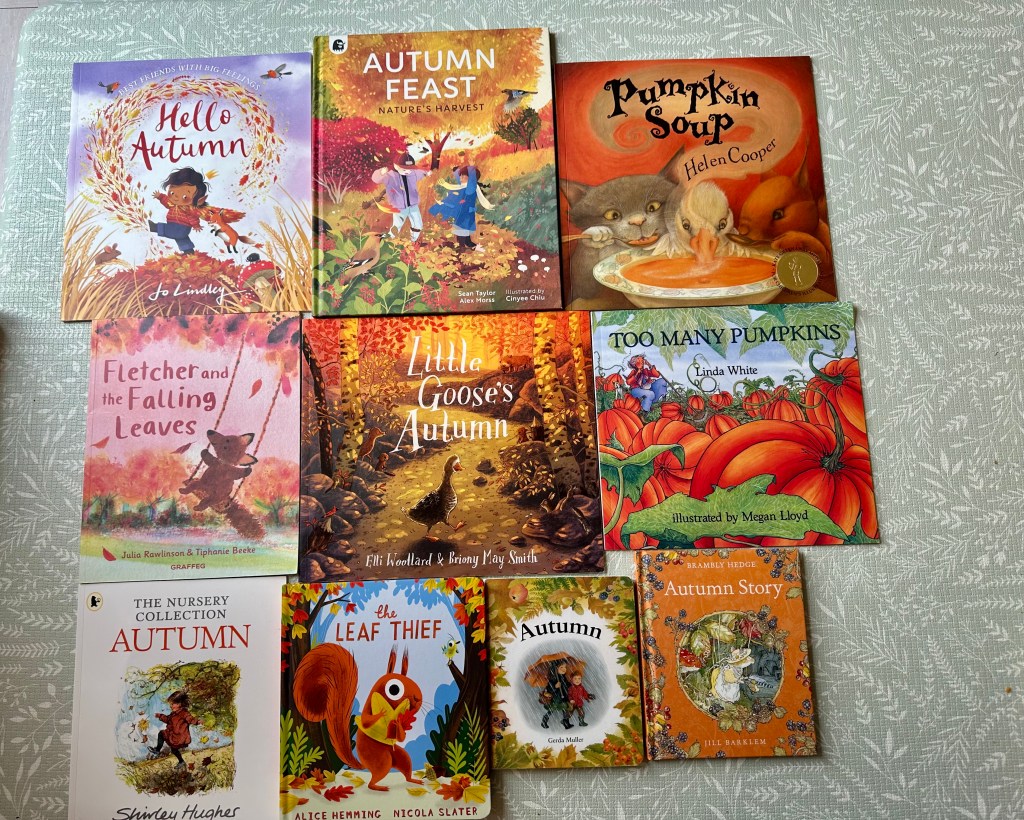
- Autumn by Gerda Muller – This is a beautiful wordless picture book and one that children can enjoy from a very young age. Even when my daughter was tiny, she would sit looking through the illustrations and pointing to things she recognised. I particularly like that the book is small enough for a young child to handle and explore independently. Without any text to dictate the story, there are so many opportunities to talk together about what we see in the pictures.
- The Nursery Collection: Autumn by Shirley Hughes – Hughes is a firm favourite in our house. Her illustrations are beautiful but also wonderfully relatable – the scenes could almost be moments from our own lives. This collection combines those images with lovely poems that capture different aspects of the season. It’s the sort of book to curl up and read together as the weather starts to cool.
- The Leaf Thief by Alice Hemming and Nicola Slater – This book is funny and really enjoyable. It doesn’t read like a conventional sotry; it has an almost comic-book feel to it, with lots of conversation between the characters. It’s a fun and engaging way to introduce children to what happens as the seasons change, without feeling like you’re sitting down to teach them about it.
- Fletcher and the Falling Leaves by Julia Rawlinson and Tiphanie Beeke – This is such a sweet story. Fletcher is a good-hearted and rather naive yound fox who becomes increasinfly concerned as the leaves begin falling from his favourite tree. He tries desperately to save the final leaf, not yet understanding that losing its leaves is simply part of the tree’s natural cycle. It’s a lovely way of exploring the changing season through a story about caring for the natural world.
- Little Goose’s Autumn by Elli Woollard and Briony May Smith – This book has wonderful illustrations and a lovely rhyming text. As Little Goose explores, we see the different ways animals are preparing for the colder months ahead. Little Goose doesn’t realise until the end that she is supposed to fly to warmer climates. It gently introduces the idea of bird migrations, making it a lovely bridge between a seasonal story and learning about what is actually happening in nature during the season.
- Hello Autumn by Jo Lindley – This is part of a series following four friends who take turns wearing the weather crown. In each book, the central character encounters some emotional difficulties, which are eventually worked through with the support of their friends. I like that the books combine the changing seasons with stories about frienship and dealing with emotions, rather than just teaching children about the weather.
- Autumn Feast: Nature’s Harvest by Sean Taylor, Alex Morss and Cinyss Chiu – This book explores the changes happening in nature and the different ways wildlife prepares for the colder months. The story follows two children with their two mums as they begin to notice the changes taking place around them. This is also part of a four-book series following the seasons, and we have all four.
- Too Many Pumpkins by Linda White – This is a lovely autumn story about second chances and community. The protagonist grew up eating so many pumpkins that she swore off them for life. When one lands in her garden, she refuses to even look at it – but it keeps growing until the whole garden is full. What follows is a warm story about connection and sharing, as the pumpkins slowly bring her back into her community.
- Pumpkin Soup by Helen Cooper – This is a firm favourite in our house. I love the rich illustrations and the cosy autumn atmosphere they create. It follows a cat, a squirrel and a duck who all live together in a little hut and make pumpkin soup the same way every day. When the duck wants to change things, a big argument breaks out. The illustrations of their faces are brilliant – so expressive they really remind me of children arguing over a toy. At its heart it is a story about friendship. When the duck leaves, the cat and squirrel realise just how much they miss him, and that being right isn’t as important as being together. The ending is lovely too, with the suggestion that another squablle is about to begin!
More autumn books from our shelves:
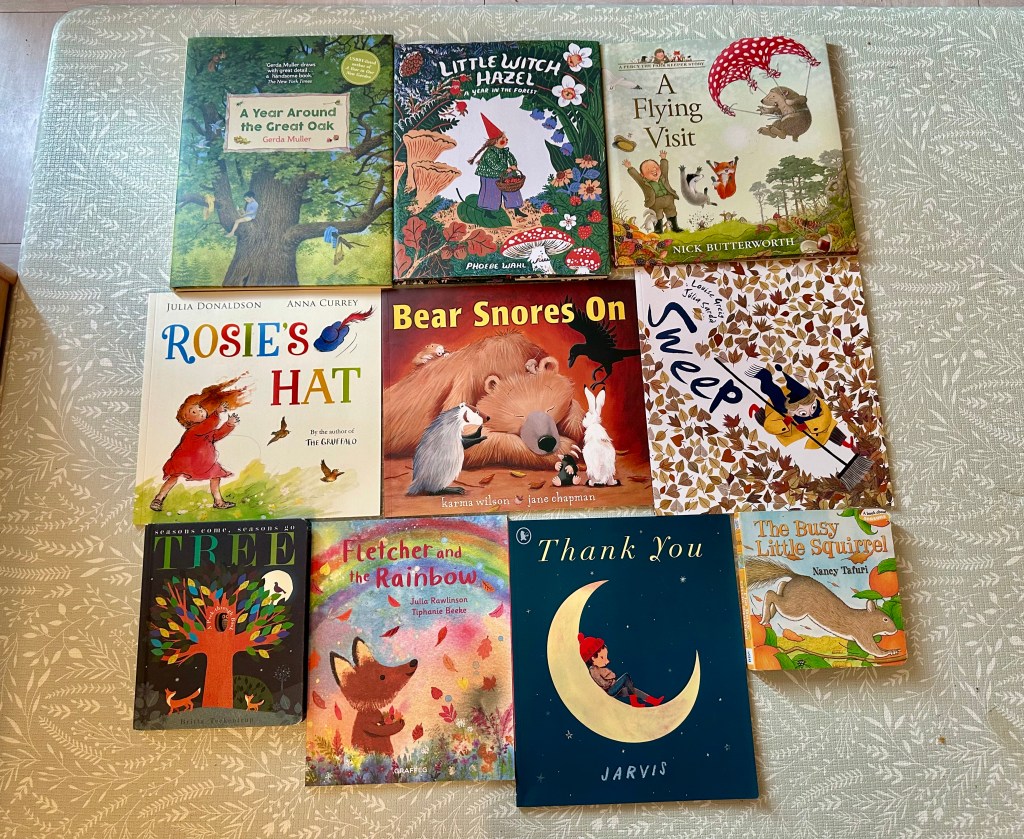
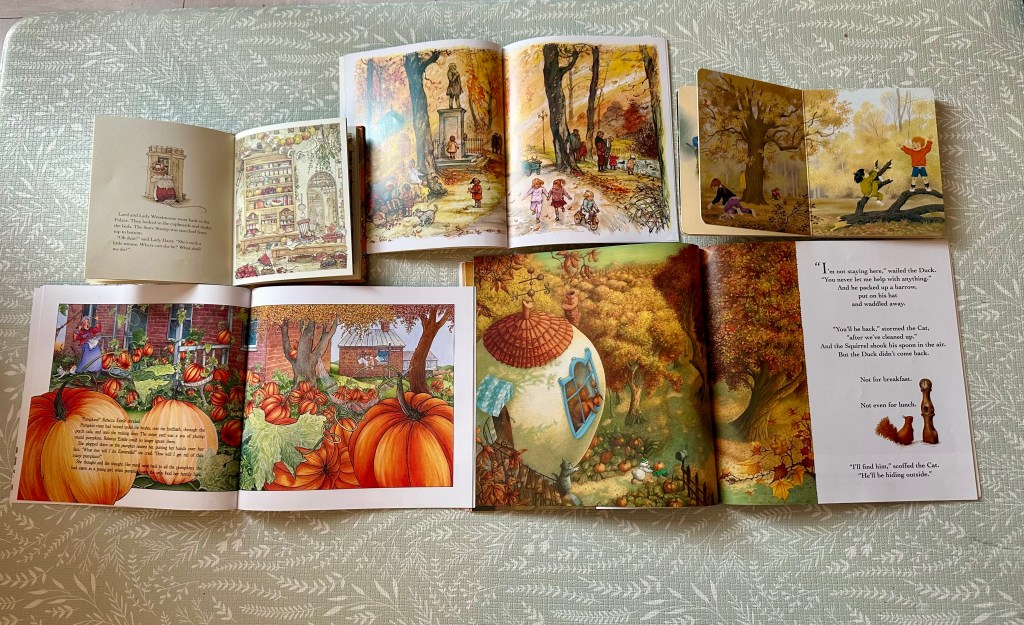
These are some of the other books that find their way into our autumn book basket. Not all of them are specifically about autumn, but they have stories, illustrations or themes that feel right for this time of year. I have collected our seasonal books gradually, so this isn’t a collection I would suggest trying to recreate all at once. We simply add books we genuinely love and look forward to bringing them out again each year.
Autumn nature, harvest and activity books
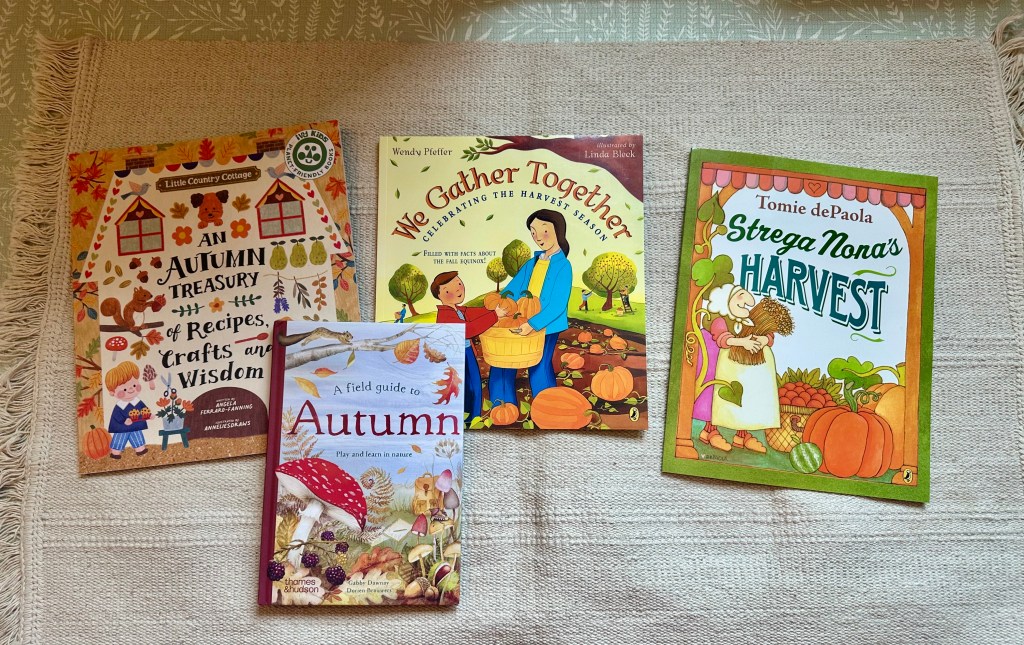
As well as stories, I like to include a few books that help us explore harvest time and what is actually happening in nature during autumn. Some books we can dip into when the children have a question or want an activity to do together.
A Field Guide to Autumn by Gabby Dawnay and Dorien Brouwers is particularly lovely for encouraging children to look more closely at the natural world while An Autumn Treasury of Recipes, Crafts and Wisdom by Angela Ferraro-Fanning gives us ideas for things we can actually do during the season rather than just read about it.
Strega Nona’s Harvest by Tomie dePaola – I adore Strega Nona, and this is such a lovely book to bring out in Autumn. The story follows Strega Nona and Big Anthony as they plant their vegetable gardens, although inevitably things don’t go according to plan. It eventually becomes a story about abundance, generosity and sharing what we have with others who need it. We have other Strega Nona books in our collection, so she is one of those characters that feels like an old friend whenever we bring out a seasonal title such as this one.
Autumn celebrations: The Mid-Autumn Festival
Autumn isn’t only about falling leaves and pumpkins. I also use the books as an opportunity to introduce the children to some of the festivals and traditions celebrated by families around the world.
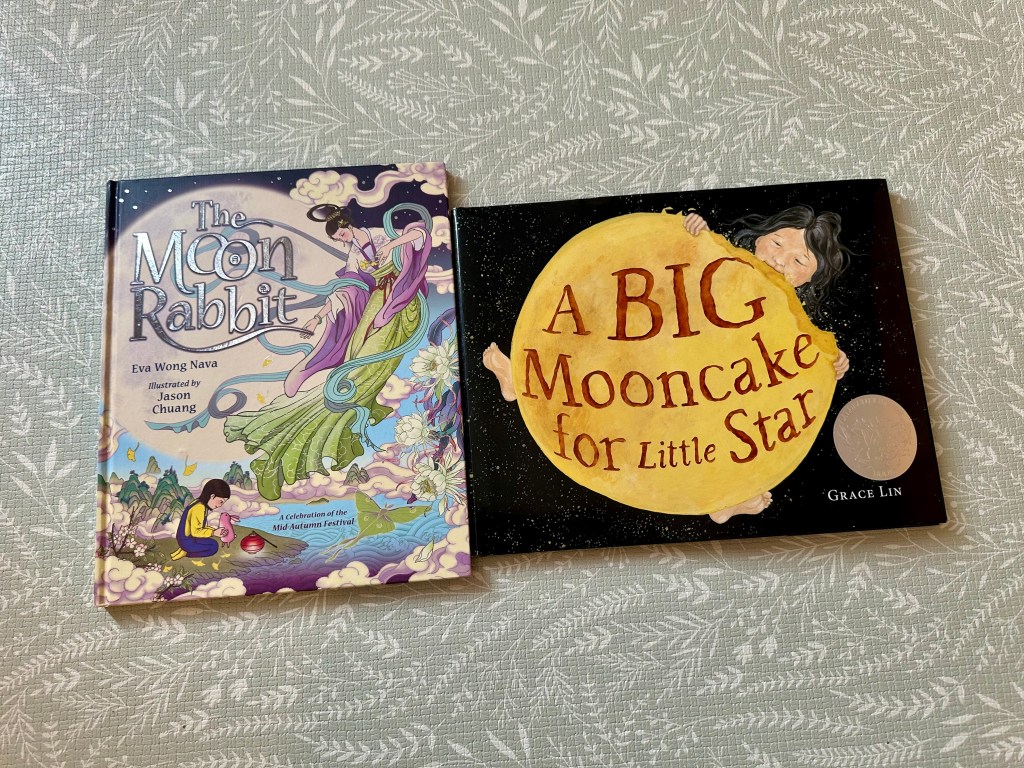
The Mid-Autumn festival, sometimes called the Moon Festival, is celebrated in China and across a number of East and Southeast Asian cultures. It takes place around the harvest moon and is associated with family gatherings, mooncakes and appreciating the full moon.
We have two beautiful picture books that help introduce some of these ideas: A Big Mooncake for Little Star by Grace Lin and The Moon Rabbit by Chou Yih-Fen. The illustrations in both are outstanding, and A Big Mooncake for Little Star received a Caldecott Honour.
For me, using books in this way fits very naturally with the Montessori. It adds an opportunity to discover the wider world and the people, celebrations and traditions within it.
Our Montessori-inspired Autumn Shelf
I change the children’s Montessori shelf weekly for most of the year. I usually follow a loose theme based upon a season, cultural event, or topics that young children seem to enjoy – such as farms, transport or space.
I think of our shelves at home as Montessori-inspired rather than an attempt to recreate a Montessori classroom. My children attend a Montessori nursery, so I don’t feel the need to duplicate lots of the materials they already have access to there. Instead, I take the principles I value from Montessori and combine them with books, open-ended toys and other materials that work well for our family.
You’ll also spot some Waldorf-inspired toys and ideas. Our Grimm’s celebration ring and seasonal figures are a good example of this. I don’t feel everything in our home needs to fit with one educational philosophy. I want to create an inviting and beautiful space that inspires my children to play, explore and learn.
For Autumn, I like to bring together a mixture of seasonal books and toys. I don’t buy a new collection of toys for each shelf. Most of what you see in the photo are things we already own and use throughout the year. Some items are selected purely for being autumnal colours.. I find rotating toys and regrouping them in this way keeps them interesting again without creating added expense or clutter.
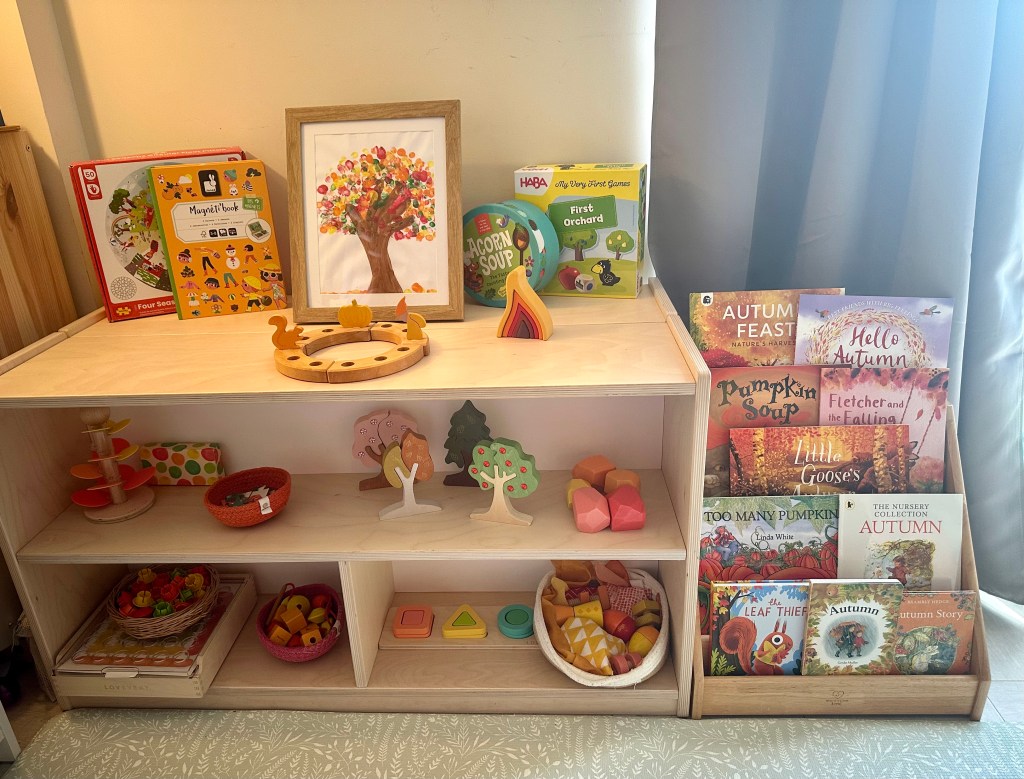
This is our autumn shelf this year. Naturally it has changed as the children grow. On the top of the shelf I’ve included our BigJigs circular seasons puzzle and Janod Seasons Magneti’Book, both of which give us opportunities to talk about the four seasons and some of the changes the children might notice throughout the year.
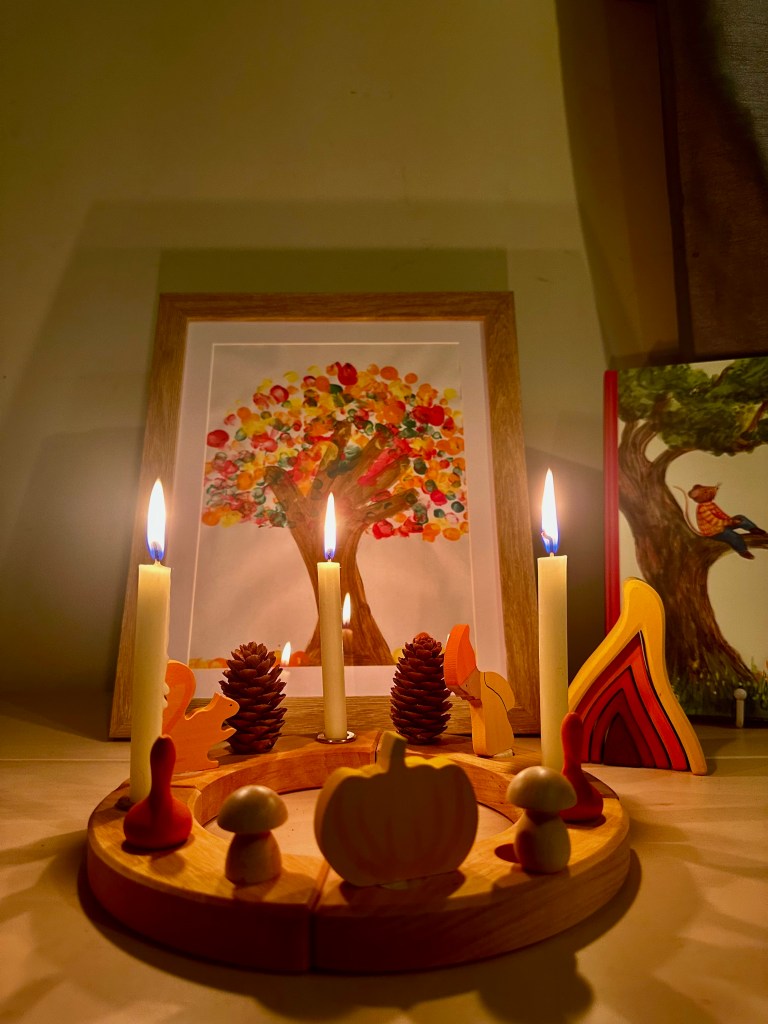
In the centre is a piece of my daughter’s autumn artwork. I love including things the children have made themselves. It makes the space feel like theirs rather than just something I have styled for them. I hope they feel pride to see their work at the heart of a display.
We also have the Peaceable Kingdom Acorn Soup game and HABA First Orchard. I particularly like bringing games like these out seasonally. The apples, acorns and woodland themes fit naturally with autumn.
I’ve added a few seasonal touches too, including our Grimm’s small fire and Grimm’s celebration ring with a squirrel, pumpkin and autumn gnome. These aren’t really activities in themselves but they do help to change the feeling of the space to mark the arrival of a new season.
On the shelves I’ve included the Lovevery Rhyming Leaves game from the Reading Skill set part 1, a Rex London autumn jigsaw, Tickit seasonal gem trees and Lovevery stacking rocks.
I’ve also used some of our everyday fine motor materials in the colours of the season. Our PlanToys lacing beads, for example can be presented using just the yellow and orange beads rather than the entire set. The same idea works with our HABA shaker eggs, Hape Twist and Turnables and Tickit nuts and bolts.
This is one of the easiest ways I’ve found to create a seasonal shelf without buying lots of seasonal toys. Sometimes it is just a matter of looking at existing toys differently and choosing only the colours that work for the season.
Our Lovevery Mosaic Button Board and Lovevery Nesting Shape puzzle are also on the shelf. They aren’t specifically autumnal, but that’s rather the point. Not everything on a seasonal shelf needs to be. They are familiar materials that the children can return to independently.
Open-ended play and our autumn treasure basket
I’ve also included a treasure basket for my youngest, which contains a mixture of tactile and open-ended materials. At the moment, this includes play silks from Kiwico and Sarah’s Silks, bean bags from the Early Learning Centre, along with the shaker eggs and twist and turn toys. There’s no set way to play for these. And often the children surprise me with their imaginative ideas.
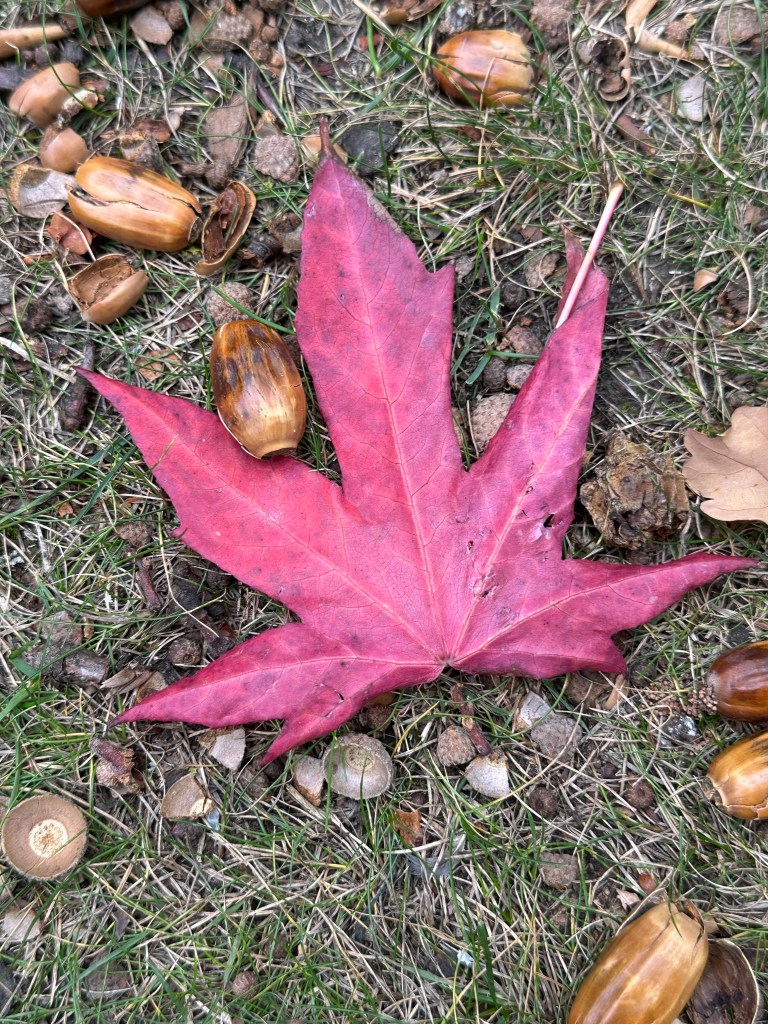
I love changing our shelves and books with the seasons, but I don’t think that means constantly buying new things. Some of our favourite moments are the simplest ones: noticing the leaves changing on our walks, collecting conkers and acorns, and reading familiar stories.
For me, that’s what our seasonal shelves are about: helping us all to slow down and notice the rhythms of the year, while keeping things simple and manageable for our family.


Leave a Reply